Students aren’t waiting for us to define AI literacy
While researchers debate definitions, your students are already navigating a complex AI landscape – often without the skills to do it safely
The conversation about artificial intelligence in education has never been louder. Governments are drafting frameworks. Academics are publishing papers. School leaders are fielding questions from parents, teachers, and boards.
And at the centre of it all is one of the most important (and contested) questions in education today: what does it mean to be AI literate? It's the right question.
Researchers such as Professor Luci Pangrazio from the Centre of Excellence for the Digital Child, are interrogating how AI literacy is defined, what it should include, and whether existing models go far enough.
Some argue that most current approaches focus too narrowly on how to use AI, without equipping young people to think critically about the systems shaping their lives. Others are asking whether literacy alone is even sufficient, or whether regulation, rights, and institutional responsibility need to carry more of the load.
What students are actually doing
Three-quarters of Australian high school students are already using AI at least a few times per week. Nearly one in four use it every single day. Generative tools like ChatGPT are used regularly for schoolwork.
New Australian research from the University of New South Wales conducted with secondary students across Years 7–10, in collaboration with Day of AI Australia, adds another dimension to this picture.
Eighty-two percent of students surveyed had already encountered deepfakes. (This number doesn’t include the number of students who have seen deepfakes but didn’t know it was fake.) Nearly one in five students had shared a deepfake. Seven percent had created one. And, critically, only a third felt confident knowing what to do if they became the subject of one.
The UNSW research found that many students don’t fully understand what AI actually is. When asked which AI tools they use most, significant numbers of students nominated TikTok, YouTube, and Instagram, platforms that use AI, but aren’t dedicated AI tools. Separately, UNSW research found that before intervention, large numbers of students didn’t recognise that Netflix, Spotify, and TikTok were AI-driven at all.
Australia’s social media ban for under-16s, which came into effect in December 2025, will shift some of these patterns.
With millions of accounts already closed, the platforms students use and how they access them are changing. But the underlying problem these findings reveal isn’t really about which platforms students use. It’s about whether they can recognise AI when they encounter it, in any form, on any service. Students are immersed in AI systems they can’t yet see. That’s not just a literacy gap. In a world where those systems are shaping what they see, believe, and do, it’s a safety gap.
Critical thinking, ethical reasoning, and responsible use
Professor Pangrazio argues that framing AI education purely as “literacy” risks turning it into a compliance exercise. In other words, it shouldn’t be about teaching students to use AI efficiently, without giving them the tools to question it or understand the power structures it operates within.
Whether you call it AI literacy, digital citizenship, or critical technology education, the goal is the same: making sure young people are safe, ethical, and responsible, and know when to use AI, and when not to. It’s not about teaching students to prompt effectively.
This means they need to understand how AI systems are trained and where bias enters. It means identifying AI-generated content and knowing what to do when you encounter it. It means thinking critically about platforms shaping what we see and believe – and understanding our rights and responsibilities in an AI-mediated world.
Regulation matters but classrooms can’t wait
Regulation is moving. Australia's new Age-Restricted Material Codes, which came into effect earlier this month, place legally enforceable obligations on tech companies to protect children from harmful content, including AI-generated material. Combined with the social media age restrictions for under-16s, responsibility is shifting toward the platforms where it belongs.
But regulation addresses access. It doesn’t build understanding. Education is critical, not as a substitute for good policy, but as a complement to it. For instance, when students can identify AI-generated content, misinformation loses some of its power. And when they know their rights, they’re better placed to exercise them.
What the evidence says works
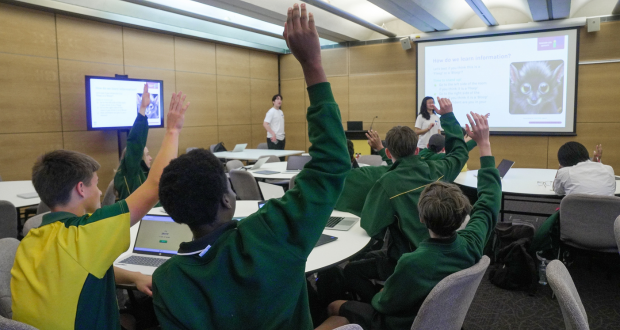
The good news is that targeted AI education works.
Research evaluating Day of AI Australia’s workshop program found that even a single-day intervention produced important gains in students’ AI knowledge and confidence. Students showed meaningfully improved understanding of how AI systems are trained, how bias operates within them, and how to navigate privacy risks.
Crucially, students also got better at recognising AI in the everyday platforms they use. They understood, for instance, that TikTok and Netflix aren’t just “algorithm-driven” but are powered by AI systems making active decisions about what they see and don’t see.
Small interventions like delivering Day of AI Australia lessons are beneficial. For many students, it may be the first structured conversation about AI they have encountered.
Free, curriculum-aligned, ready to deliver
Day of AI Australia provides free curriculum-aligned materials covering AI concepts, ethics, safety, and real-world application. Designed for Australian primary and secondary students and deliverable by any classroom teacher. Expert-developed, teacher-tested, and free.
Day of AI Australia is brought to you by AI in Schools Ltd, a registered charity supported by UNSW Sydney, Google.org, Microsoft, Rokt, CDC Data Centres, Commonwealth Bank, Officeworks, TDM Foundation, P&S Bassat Foundation, Square Peg.
Learn more about the Day of AI Australia program at our website.
Do you have an idea for a story?Email rcox@intermedia.com.au